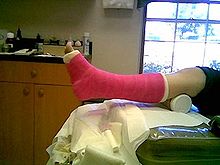
An orthopedic cast, or just cast, is a shell, every now and again produced using mortar or fiberglass, encasing an appendage (or, at times, expansive parts of the body) to balance out and hold anatomical structures, frequently a broken bone (or bones), set up until the point when mending is affirmed. It is comparative in capacity to a support.

Mortar swathes comprise of a cotton wrap that has been joined with mortar of paris, which solidifies after it has been made wet. Mortar of Paris is calcined gypsum (broiled gypsum), ground to a fine powder by processing. At the point when water is included, the more dissolvable type of calcium sulfate comes back to the moderately insoluble frame, and warmth is created.
2 (CaSO4·½ H2O) + 3 H2O → 2 (CaSO4.2H2O) + Heat[1]
The setting of unmodified mortar begins around 10 minutes in the wake of blending and is finished in around 45 minutes; be that as it may, the cast isn't completely dry for 72 hours.[2]
These days wraps of engineered materials are regularly utilized, frequently weaved fiberglass gauzes impregnated with polyurethane, in some cases swathes of thermoplastic. These are lighter and dry substantially speedier than mortar swathes. In any case, mortar can be all the more effectively formed to make a cozy and thusly more agreeable fit. Likewise, mortar is much smoother and does not catch attire or scrape the skin.
Because of the idea of the dressing in that the appendage is inaccessible amid treatment; the skin under the mortar ends up dry and textured in light of the fact that the disposed of external skin cells are not washed or dismissed. Likewise, mortar of Paris throws can bring about cutaneous entanglements including macerations, ulcerations, diseases, rashes, tingling, consumes, and unfavorably susceptible contact dermatitis, which may likewise be because of the nearness of formaldehyde inside the mortar wraps. In sweltering climate, staphylococcal contamination of the hair follicles and sweat organs can prompt extreme and agonizing dermatitis.
Different impediments of mortar throws incorporate their weight, which can be very impressive, therefore confining development, particularly of a tyke. Expulsion of the cast requires annihilating the cast itself. The procedure is regularly loud, making utilization of an extraordinary wavering saw that can without much of a stretch cut the hard cast material yet experiences issues cutting delicate material like cast cushioning or skin. In spite of the fact that the expulsion is regularly easy, this can be troubling for the patient, particularly kids. A cast saw can cut, rub, or consume skin, yet those outcomes are uncommon.[4] Additionally, mortar of Paris throws separate if patients get them wet.
Because of the impediments of mortar of Paris, specialists have likewise tried different things with different sorts of materials for use as supports. An early plastic like material was gutta-percha gotten from the latex of trees found in Malaya. It took after elastic, however contained more gums. At the point when dry it was hard and inelastic, however when warmed it turned out to be delicate and pliable. In 1851 Utterhoeven, depicted the utilization of supports produced using this material for the treatment of cracks. In the 1970s, the improvement of fiberglass throwing tape made it conceivable to create a cast that was lighter and more strong than the conventional mortar cast and furthermore impervious to water (despite the fact that the wraps underneath were not) enabling the patient to be more dynamic.
In the 1990s the presentation of new cast fixing has implied that fiberglass throws with this liner are totally waterproof, enabling patients to bathe, shower, and swim while wearing a cast. The waterproof cast liner anyway adds around 2 to 3 more minutes to the application time of the cast and builds the cost of the cast.Drying time, be that as it may, can be badly sufficiently arranged to warrant a cast and gauze dampness defender. These waterproof spreads consider washing and showering while at the same time wearing either a mortar or fiberglass cast. The waterproof cast cover stays firmly around the cast and keeps water from regularly achieving it while the patient is in contact with water. The cover can undoubtedly be evacuated to dry, and can be re-utilized regularly.
Cast writes
Furthest point throws
Furthest point throws are those which encase the arm, wrist, as well as hand. A long arm cast encases the arm from the hand to around 2 creeps beneath the arm pit, leaving the fingers and thumbs free. A short arm cast, conversely, stops just beneath the elbow. The two assortments may, contingent upon the damage and the specialist's choice, incorporate at least one fingers or the thumb, in which case it is known as a finger spica or thumb spica cast.
Lower furthest point throws
Lower furthest point throws are characterized comparably, with a thrown encasing both the foot and the leg to the hip being known as a long leg cast, while a cast encasing the patient's foot, lower leg and lower leg finishing underneath the knee is alluded to as a short leg cast. A mobile foot sole area might be connected for ambulation. These foot sole areas, when appropriately connected, hoist the toes and offer the wearer the upside of keeping the toes out of the earth and dampness of the road. The strolling heel gives a little contact fix to the cast and makes a liquid shaking movement amid the walk and enables the cast to turn effortlessly toward any path. Likewise, a cast shoe/cast boot/cast shoe might be given to the patient to be utilized amid ambulation of the immobilized appendage amid healing (alluded to as being weight bearing). Furthermore, a castshoe might be utilized to just ensure the patient's threw foot while keeping up a higher level of cleanliness by keeping the cast from specifically reaching conceivably grimy or wet ground surfaces. Where the patient isn't to stroll on the harmed appendage, bolsters or a wheelchair might be given. The foot's under-bottom bit of a leg cast might be broadened ending at the tip of the patient's toes, to make an inflexible help which limits movement of the metatarsals in both weight bearing and non-weight bearing leg throws. These are alluded to as toeplates in the orthopedic train of pharmaceutical. This option might be connected to additionally bolster and balance out the metatarsals by restricting movement through a higher level of immobilization, and also shielding the toes from extra limit constrain injury. Commonly leg throws which fuse a toeplate are recommended for wounds to the foot and metatarsals. Customarily, a leg cast connected for the treatment of a steady lower leg crack would not utilize the toeplate plan in light of the fact that there is no compelling reason to immobilize and confine the movement of the patient's toes.
Barrel cast
At times, a cast may incorporate the upper and lower arm and the elbow, yet leave the wrist and hand free, or the upper and lower leg and the knee, leaving the foot and lower leg free. Such a cast might be known as a barrel cast. Where the wrist or lower leg is incorporated, it might be known as a long arm or long leg cast.
Body throws
Body throws, which cover the storage compartment of the body, and at times the neck up to or including the head (see Minerva Cast, underneath) or at least one appendages, are once in a while utilized today, and are most usually utilized as a part of the instances of little youngsters, who can't be trusted to consent to a back support, or in instances of radical medical procedure to repair damage or other deformity. A body cast which encases the storage compartment (with "lashes" over the shoulders) is generally alluded to as a body coat. These are regularly exceptionally awkward.
EDF cast
An EDF (stretching, derotation, flexion) cast is utilized for the treatment of Infantile Idiopathic scoliosis. This technique for treatment for revision was created by UK scoliosis pro Min Mehta.[6] Scoliosis is a 3-dimensional issue that should be rectified on every one of the 3 planes. The EDF throwing technique can lengthen the spine through footing, derotate the spine/pelvis, and to enhance lordosis and general body shape and arrangement.
EDF varies from Risser throwing. EDF throws are either finished or under the shoulder, and have a substantial mushroom opening on the front to take into account appropriate chest development. On the back, there is a little pattern on the concavity of the bend, not going past the midline. It was discovered that the spine turned out to be more lined up with this pattern than without, and that it remedied revolution.
Spica cast
A cast which incorporates the storage compartment of the body and at least one appendages is known as a spica cast, similarly as a cast which incorporates the "storage compartment" of the arm and at least one fingers or the thumb is. For instance, a shoulder spica incorporates the storage compartment of the body and one arm, for the most part to the wrist or hand. Shoulder spicas are never observed today, having been supplanted with specific supports and slings which permit early versatility of the damage in order to stay away from joint solidness in the wake of recuperating.
A hip spica incorporates the storage compartment of the body and at least one legs. A hip spica which covers just a single leg to the lower leg or foot might be alluded to as a solitary hip spica, while one which covers the two legs is known as a twofold hip spica. A one-and-a-half hip spica encases one leg to the lower leg or foot and the other to simply over the knee. The degree to which the hip spica covers the storage compartment depends incredibly on the damage and the specialist; the spica may stretch out just to the navel, permitting versatility of the spine and the likelihood of strolling with the guide of bolsters, or may reach out to the rib confine or even to the armpits in some uncommon cases. Hip spicas were in the past basic in lessening femoral breaks, yet today are once in a while utilized aside from intrinsic hip separations, and after that for the most part while the tyke is as yet a newborn child.
Sometimes, a hip spica may just stretch out down at least one legs to over the knee. Such throws, called pantaloon throws, are once in a while observed to immobilize a harmed lumbar spine or pelvis, in which case the storage compartment segment of the cast for the most part stretches out to the armpits.
Mortar swathes comprise of a cotton wrap that has been joined with mortar of paris, which solidifies after it has been made wet. Mortar of Paris is calcined gypsum (broiled gypsum), ground to a fine powder by processing. At the point when water is included, the more dissolvable type of calcium sulfate comes back to the moderately insoluble frame, and warmth is created.
2 (CaSO4·½ H2O) + 3 H2O → 2 (CaSO4.2H2O) + Heat[1]
The setting of unmodified mortar begins around 10 minutes in the wake of blending and is finished in around 45 minutes; be that as it may, the cast isn't completely dry for 72 hours.[2]
These days wraps of engineered materials are regularly utilized, frequently weaved fiberglass gauzes impregnated with polyurethane, in some cases swathes of thermoplastic. These are lighter and dry substantially speedier than mortar swathes. In any case, mortar can be all the more effectively formed to make a cozy and thusly more agreeable fit. Likewise, mortar is much smoother and does not catch attire or scrape the skin.
Because of the idea of the dressing in that the appendage is inaccessible amid treatment; the skin under the mortar ends up dry and textured in light of the fact that the disposed of external skin cells are not washed or dismissed. Likewise, mortar of Paris throws can bring about cutaneous entanglements including macerations, ulcerations, diseases, rashes, tingling, consumes, and unfavorably susceptible contact dermatitis, which may likewise be because of the nearness of formaldehyde inside the mortar wraps. In sweltering climate, staphylococcal contamination of the hair follicles and sweat organs can prompt extreme and agonizing dermatitis.
Different impediments of mortar throws incorporate their weight, which can be very impressive, therefore confining development, particularly of a tyke. Expulsion of the cast requires annihilating the cast itself. The procedure is regularly loud, making utilization of an extraordinary wavering saw that can without much of a stretch cut the hard cast material yet experiences issues cutting delicate material like cast cushioning or skin. In spite of the fact that the expulsion is regularly easy, this can be troubling for the patient, particularly kids. A cast saw can cut, rub, or consume skin, yet those outcomes are uncommon.[4] Additionally, mortar of Paris throws separate if patients get them wet.
Because of the impediments of mortar of Paris, specialists have likewise tried different things with different sorts of materials for use as supports. An early plastic like material was gutta-percha gotten from the latex of trees found in Malaya. It took after elastic, however contained more gums. At the point when dry it was hard and inelastic, however when warmed it turned out to be delicate and pliable. In 1851 Utterhoeven, depicted the utilization of supports produced using this material for the treatment of cracks. In the 1970s, the improvement of fiberglass throwing tape made it conceivable to create a cast that was lighter and more strong than the conventional mortar cast and furthermore impervious to water (despite the fact that the wraps underneath were not) enabling the patient to be more dynamic.
In the 1990s the presentation of new cast fixing has implied that fiberglass throws with this liner are totally waterproof, enabling patients to bathe, shower, and swim while wearing a cast. The waterproof cast liner anyway adds around 2 to 3 more minutes to the application time of the cast and builds the cost of the cast.Drying time, be that as it may, can be badly sufficiently arranged to warrant a cast and gauze dampness defender. These waterproof spreads consider washing and showering while at the same time wearing either a mortar or fiberglass cast. The waterproof cast cover stays firmly around the cast and keeps water from regularly achieving it while the patient is in contact with water. The cover can undoubtedly be evacuated to dry, and can be re-utilized regularly.
Cast writes
Furthest point throws
Furthest point throws are those which encase the arm, wrist, as well as hand. A long arm cast encases the arm from the hand to around 2 creeps beneath the arm pit, leaving the fingers and thumbs free. A short arm cast, conversely, stops just beneath the elbow. The two assortments may, contingent upon the damage and the specialist's choice, incorporate at least one fingers or the thumb, in which case it is known as a finger spica or thumb spica cast.
Lower furthest point throws
Lower furthest point throws are characterized comparably, with a thrown encasing both the foot and the leg to the hip being known as a long leg cast, while a cast encasing the patient's foot, lower leg and lower leg finishing underneath the knee is alluded to as a short leg cast. A mobile foot sole area might be connected for ambulation. These foot sole areas, when appropriately connected, hoist the toes and offer the wearer the upside of keeping the toes out of the earth and dampness of the road. The strolling heel gives a little contact fix to the cast and makes a liquid shaking movement amid the walk and enables the cast to turn effortlessly toward any path. Likewise, a cast shoe/cast boot/cast shoe might be given to the patient to be utilized amid ambulation of the immobilized appendage amid healing (alluded to as being weight bearing). Furthermore, a castshoe might be utilized to just ensure the patient's threw foot while keeping up a higher level of cleanliness by keeping the cast from specifically reaching conceivably grimy or wet ground surfaces. Where the patient isn't to stroll on the harmed appendage, bolsters or a wheelchair might be given. The foot's under-bottom bit of a leg cast might be broadened ending at the tip of the patient's toes, to make an inflexible help which limits movement of the metatarsals in both weight bearing and non-weight bearing leg throws. These are alluded to as toeplates in the orthopedic train of pharmaceutical. This option might be connected to additionally bolster and balance out the metatarsals by restricting movement through a higher level of immobilization, and also shielding the toes from extra limit constrain injury. Commonly leg throws which fuse a toeplate are recommended for wounds to the foot and metatarsals. Customarily, a leg cast connected for the treatment of a steady lower leg crack would not utilize the toeplate plan in light of the fact that there is no compelling reason to immobilize and confine the movement of the patient's toes.
Barrel cast
At times, a cast may incorporate the upper and lower arm and the elbow, yet leave the wrist and hand free, or the upper and lower leg and the knee, leaving the foot and lower leg free. Such a cast might be known as a barrel cast. Where the wrist or lower leg is incorporated, it might be known as a long arm or long leg cast.
Body throws
Body throws, which cover the storage compartment of the body, and at times the neck up to or including the head (see Minerva Cast, underneath) or at least one appendages, are once in a while utilized today, and are most usually utilized as a part of the instances of little youngsters, who can't be trusted to consent to a back support, or in instances of radical medical procedure to repair damage or other deformity. A body cast which encases the storage compartment (with "lashes" over the shoulders) is generally alluded to as a body coat. These are regularly exceptionally awkward.
EDF cast
An EDF (stretching, derotation, flexion) cast is utilized for the treatment of Infantile Idiopathic scoliosis. This technique for treatment for revision was created by UK scoliosis pro Min Mehta.[6] Scoliosis is a 3-dimensional issue that should be rectified on every one of the 3 planes. The EDF throwing technique can lengthen the spine through footing, derotate the spine/pelvis, and to enhance lordosis and general body shape and arrangement.
EDF varies from Risser throwing. EDF throws are either finished or under the shoulder, and have a substantial mushroom opening on the front to take into account appropriate chest development. On the back, there is a little pattern on the concavity of the bend, not going past the midline. It was discovered that the spine turned out to be more lined up with this pattern than without, and that it remedied revolution.
Spica cast
A cast which incorporates the storage compartment of the body and at least one appendages is known as a spica cast, similarly as a cast which incorporates the "storage compartment" of the arm and at least one fingers or the thumb is. For instance, a shoulder spica incorporates the storage compartment of the body and one arm, for the most part to the wrist or hand. Shoulder spicas are never observed today, having been supplanted with specific supports and slings which permit early versatility of the damage in order to stay away from joint solidness in the wake of recuperating.
A hip spica incorporates the storage compartment of the body and at least one legs. A hip spica which covers just a single leg to the lower leg or foot might be alluded to as a solitary hip spica, while one which covers the two legs is known as a twofold hip spica. A one-and-a-half hip spica encases one leg to the lower leg or foot and the other to simply over the knee. The degree to which the hip spica covers the storage compartment depends incredibly on the damage and the specialist; the spica may stretch out just to the navel, permitting versatility of the spine and the likelihood of strolling with the guide of bolsters, or may reach out to the rib confine or even to the armpits in some uncommon cases. Hip spicas were in the past basic in lessening femoral breaks, yet today are once in a while utilized aside from intrinsic hip separations, and after that for the most part while the tyke is as yet a newborn child.
Sometimes, a hip spica may just stretch out down at least one legs to over the knee. Such throws, called pantaloon throws, are once in a while observed to immobilize a harmed lumbar spine or pelvis, in which case the storage compartment segment of the cast for the most part stretches out to the armpits.
